
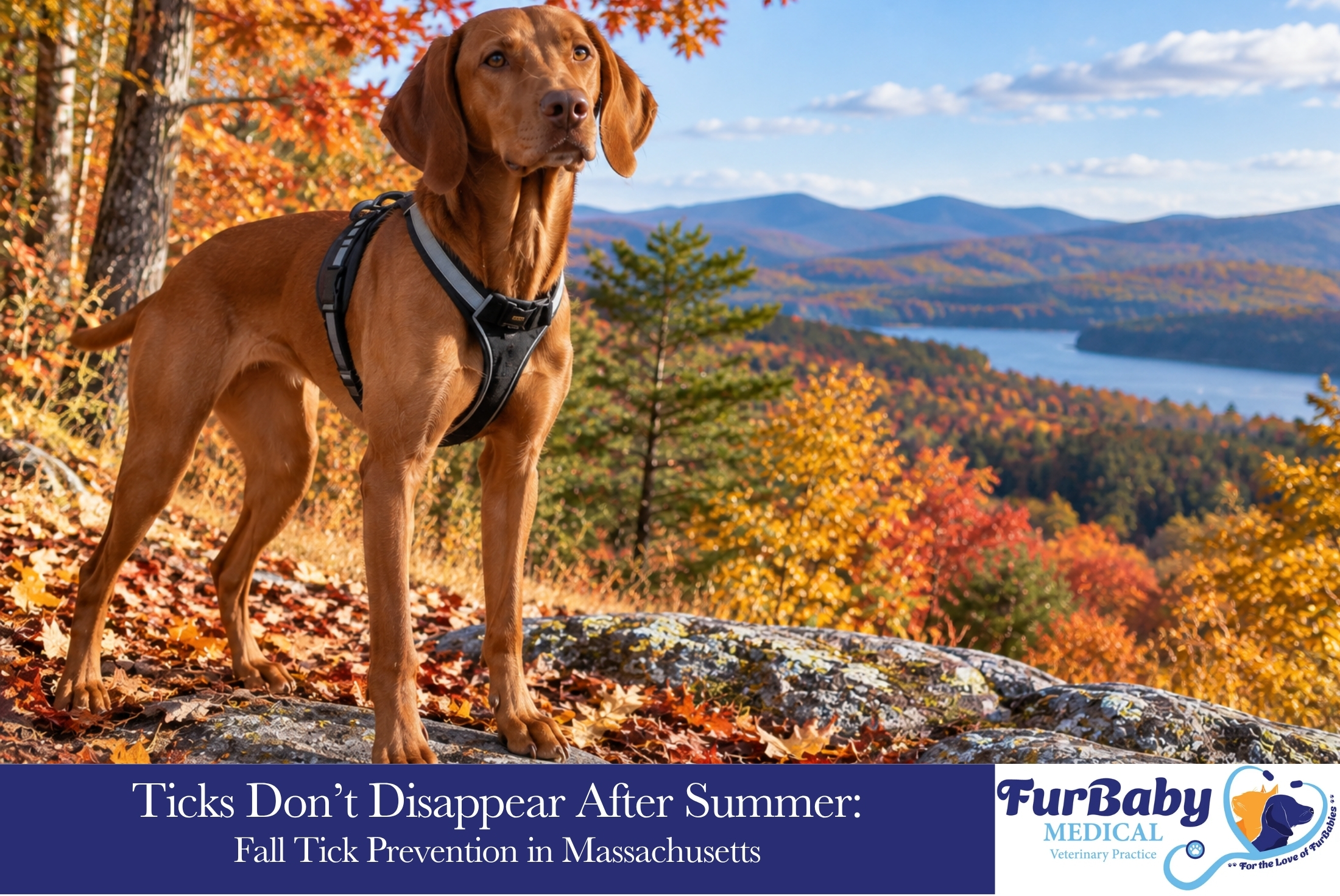
When summer ends in Massachusetts, it’s easy to assume that flea and tick season is winding down. Cooler mornings, changing leaves, and shorter days may make insects less noticeable—but ticks are a different story.
Ticks don’t disappear when summer ends.
In Massachusetts, blacklegged ticks—commonly called deer ticks—remain an important concern throughout the fall. Adult blacklegged ticks can even become active during winter when temperatures rise above freezing.
For dogs, cats, and the people who love them, this means parasite prevention shouldn’t automatically stop when the calendar reaches September or October.
At Furbaby Medical Veterinary Practice in Ware, we encourage pet parents to think about flea and tick prevention as an ongoing part of preventive veterinary care.
Why Fall Is Still Tick Season in Massachusetts
Cooler Weather Doesn’t Mean Ticks Are Gone
Ticks are remarkably resilient.
Blacklegged ticks are particularly important in Massachusetts because they can transmit pathogens associated with several illnesses, including Lyme disease and anaplasmosis.
Unlike pests that disappear quickly with cooler weather, blacklegged ticks can remain active throughout the fall. Adult ticks may also search for hosts during warmer periods of winter.
That makes the traditional idea of a short, clearly defined “tick season” misleading for New England pet owners.
Fall Activities Can Increase Exposure
Autumn is a great time to be outside with your Furbaby.
Hiking, walking through wooded neighborhoods, visiting parks, camping, hunting, playing in the backyard, and exploring leaf-covered areas can all provide opportunities for tick exposure.
Ticks are commonly encountered in grassy, brushy, wooded, and leaf-covered environments. Your pet doesn’t have to venture deep into the woods to encounter one—exposure can occur in yards and neighborhoods too.
The Deer Tick: Small but Important
The blacklegged tick (Ixodes scapularis) is commonly called the deer tick and is widespread throughout the Northeast.
These ticks can be surprisingly difficult to find, particularly on pets with thick, dark, or long coats.
Blacklegged tick nymphs can be approximately the size of a poppy seed, while adults may be roughly the size of a sesame seed.
That’s one reason regular tick checks remain important even when your pet receives preventive medication.
Lyme Disease and Dogs
Lyme disease is caused by Borrelia bacteria transmitted through the bite of infected blacklegged ticks.
Dogs can encounter ticks during ordinary activities such as walking around the neighborhood, playing near wooded property lines, exploring tall grass or brush, visiting parks, hiking, camping, or simply spending time in their own backyard.
Signs of Tick-Borne Disease
Symptoms can vary depending on the organism involved, and illness may not become apparent immediately after a tick bite.
Signs that deserve veterinary attention can include:
- Fever
- Lethargy or unusual tiredness
- Decreased appetite
- Joint discomfort
- Limping or shifting-leg lameness
- Swollen or painful joints
- Enlarged lymph nodes
- Reluctance to exercise or play
- Unexplained changes in behavior
Some infected animals initially show few or no obvious symptoms, which is another reason preventive care and individualized screening are important.
Why We Recommend Consistent Tick Prevention
One problem with stopping and restarting parasite prevention is trying to predict exactly when ticks will become inactive—and when they will become active again.
Massachusetts weather doesn’t follow a perfectly predictable schedule. Cold weather can be followed by warmer days, allowing adult blacklegged ticks to become active again.
Consistent prevention removes much of that guesswork.
Tick Prevention Isn’t One-Size-Fits-All
The appropriate preventive depends on your pet’s:
- Species
- Age
- Weight
- Medical history
- Lifestyle
- Travel
- Exposure risk
- Other medications
- Previous reactions or sensitivities
Different preventive options are available, and your veterinarian can help determine which approach is appropriate for your individual Furbaby.
A Special Warning for Cat Owners
Never use a dog flea or tick product on a cat unless specifically directed by your veterinarian.
Some ingredients or concentrations that are appropriate for dogs can be dangerous to cats. Never assume parasite-control products are interchangeable between species.
What About the Lyme Vaccine?
For dogs living in or traveling through areas where Lyme disease occurs, Lyme vaccination may be recommended as part of a broader prevention strategy.
However, Lyme vaccination doesn’t replace tick prevention.
Depending on the individual dog, a comprehensive strategy may include:
Veterinary-recommended tick prevention + regular tick checks + prompt tick removal + Lyme vaccination when appropriate.
At Furbaby Medical, we can discuss your dog’s lifestyle and exposure risk to determine whether Lyme vaccination should be part of their preventive-care plan.
How to Check Your Furbaby for Ticks
For pets that spend time outdoors, make tick checks part of your routine—particularly after hiking, walking through brush, or other outdoor activities.
Run your hands slowly over your pet and feel for small bumps. Part the fur and use good lighting when necessary.
Pay particular attention to:
- In and around the ears
- Around the eyelids and face
- Under the collar
- Neck and shoulders
- Under the front legs
- Between the toes
- Between the back legs
- Groin
- Around the tail
Long-haired and dark-coated pets may require an especially careful examination.
What Should You Do If You Find a Tick?
Remove an attached tick promptly.
Using fine-tipped tweezers or an appropriate tick-removal tool, grasp the tick as close to the skin as possible and pull upward using steady, even pressure.
Avoid crushing the tick with your fingers.
If you’re uncomfortable removing it, can’t remove it completely, notice significant irritation around the bite, or have concerns about your pet afterward, contact your veterinarian.
Keep Watching After a Tick Bite
Finding an attached tick doesn’t automatically mean your pet will become ill.
Continue monitoring for changes in:
Appetite • Energy • Mobility • Behavior • Overall health
If something seems unusual, contact your veterinarian and mention the recent tick exposure.
Your Pet Can Bring Ticks Inside
Tick prevention isn’t only about protecting your pet.
Pets can carry unattached ticks into the home on their coats. Those ticks may later attach to another pet—or a person.
After hiking, walking through brush, or spending significant time outdoors, checking your Furbaby before settling back inside is a good habit.
Make Your Yard Less Tick-Friendly
You can’t eliminate every tick outdoors, but you can make frequently used areas less inviting.
Consider:
- Removing accumulated leaf litter
- Clearing tall grass and brush around the home
- Mowing regularly
- Keeping play and recreational areas away from wooded edges
- Keeping heavily used areas clear of excessive leaves and vegetation
Fall leaf cleanup isn’t just about appearances. Leaf litter and vegetation can provide the moisture and shelter ticks need.
Common Fall Tick-Prevention Mistakes
Stopping prevention after Labor Day: September doesn’t mark the end of tick exposure in Massachusetts.
Waiting for the first frost: Frost isn’t an “all clear.” Blacklegged ticks can remain present and become active again when temperatures rise.
Assuming indoor pets have zero risk: Risk may be lower, but other pets and people can potentially carry ticks indoors.
Skipping tick checks because your pet takes prevention: Preventive medication is an important defense, but physical checks add another layer of protection.
Using the same product for every pet: Species, weight, age, health history, medications, and lifestyle all matter.
Fall Is a Good Time for a Preventive-Care Check
Rather than discontinuing parasite prevention in the fall, use the change of seasons as an opportunity to review your Furbaby’s preventive-care plan.
Ask yourself:
- Is my pet’s flea and tick prevention current?
- Have we missed or delayed a dose?
- Has my pet’s lifestyle or exposure risk changed?
- Are we hiking, camping, hunting, or spending more time outdoors?
- Should my dog receive a Lyme vaccine?
- Is my pet due for tick-borne disease screening?
- Do I know how to perform a thorough tick check?
Your veterinarian can help answer these questions based on your pet’s individual health and risk factors.
Frequently Asked Questions
Are ticks still active in Massachusetts during the fall?
Yes. Blacklegged ticks remain an important concern throughout the fall, and adult ticks can become active during warmer periods of winter.
Should I stop tick prevention when summer ends?
Don’t assume parasite prevention is no longer necessary simply because summer has ended. Discuss an appropriate ongoing prevention strategy with your veterinarian.
Can my dog get Lyme disease in the fall?
Yes. Dogs can encounter infected blacklegged ticks during fall outdoor activities, and Massachusetts is located in a region where Lyme disease is an important concern.
Does the first frost kill all the ticks?
No. A frost shouldn’t be considered the end of tick risk. Adult blacklegged ticks can become active again during milder conditions.
Can cats get ticks?
Yes. Cats can encounter ticks, particularly when they spend time outdoors. Only use parasite preventives that are specifically appropriate for cats and recommended for your individual pet.
Does the Lyme vaccine mean my dog doesn’t need tick prevention?
No. Lyme vaccination doesn’t prevent ticks from attaching and doesn’t protect against every disease ticks can transmit. Tick prevention and regular checks remain important.
When should I call my veterinarian after finding a tick?
Contact your veterinarian if your pet develops fever, decreased appetite, unusual fatigue, limping, joint discomfort, behavioral changes, or another unexplained illness following possible tick exposure.
Protect Your Furbaby Beyond the Summer Months
Massachusetts pet parents shouldn’t let cooler temperatures create a false sense of security.
Fall is still tick season.
Consistent parasite prevention, regular tick checks, prompt tick removal, thoughtful yard maintenance, and appropriate veterinary care provide a stronger defense than relying on the calendar.
At Furbaby Medical Veterinary Practice, we can help develop an individualized parasite-prevention strategy based on your Furbaby’s species, age, lifestyle, medical history, and exposure risk.
If your pet develops illness or another concern that needs prompt attention and shouldn’t wait for a routine appointment, Furbaby Medical also offers Sunday Veterinary Urgent Care from 10:00 AM–4:00 PM.
Contact Furbaby Medical
Furbaby Medical Veterinary Practice LLC
124 West St., Suite F
Ware, MA 01082
(864) 387-2229
Sunday: 10:00 AM–4:00 PM — Urgent Care
Monday: Closed
Tuesday: 9:00 AM–6:00 PM
Wednesday: 9:00 AM–6:00 PM
Thursday: Closed
Friday: 9:00 AM–6:00 PM
Saturday: 9:00 AM–3:00 PM


